
After Building Your Mini-Game: 4 User Acquisition Channels Compared and Low-Cost Strategies
After finishing your mini-game, many developers hit a wall here—the game is done, launched, and then… nobody plays it.
Your WeChat backend’s daily active user data looks like an ECG, a few users per day, occasionally jumping to double digits, then crashing back down the next day. I’ve seen plenty of developers venting in groups: “Spent 300 on paid acquisition, got 5 activations, zero retention.”
The problem isn’t the game itself—you may have built something fun. The problem lies in mini-game user acquisition. 67% of new users come from paid acquisition. In other words, without buying traffic, you almost have no entry ticket.
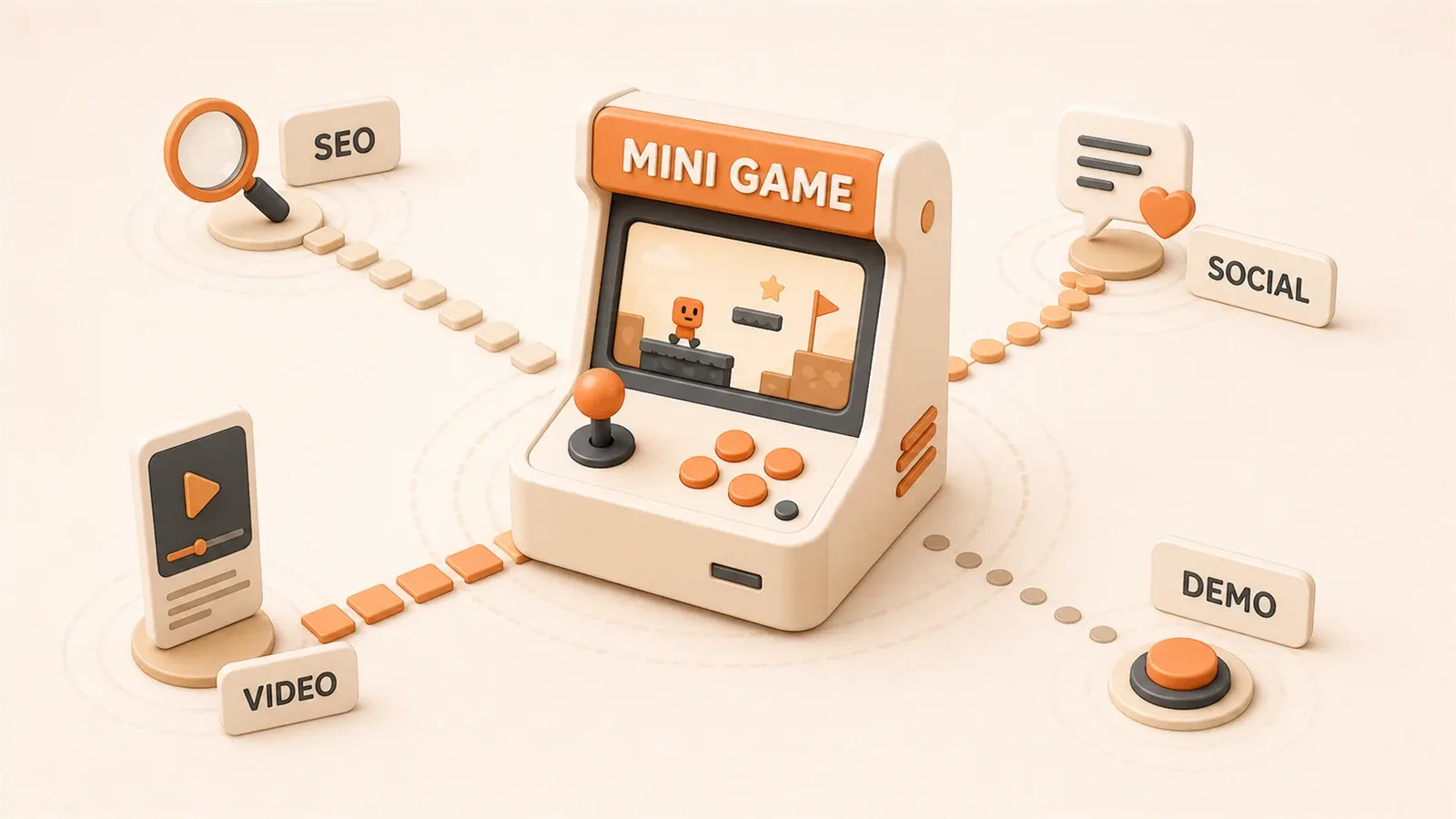
This article won’t teach you to throw money at paid acquisition. Instead, let’s discuss four low-cost user acquisition channels: Xiaohongshu seeding, short video marketing, playable page conversion, and blog SEO. I’ll use real data to tell you which channel fits your game type and the specific strategies to use.
First, Look at the Big Picture to Know What Game You’re Playing
The 2025 mini-program game market revenue hit 53.54 billion yuan, up 34.39% year-over-year. Sounds like a big pie, but too many people are slicing it—45,000 products competing for users.
WeChat mini-games have 571 million monthly active users, Douyin mini-games have 171 million. The user pool isn’t small, but 67% of new users come from paid acquisition. This number is intimidating—meaning if you don’t buy traffic, you almost have no chance with organic growth.
Another detail worth noting: the mini-game user demographic has shifted. Users over 40 account for more than 40%, and lower-tier market users make up nearly 60%. If your game targets young players, you might find your target audience isn’t even on WeChat mini-games.
Monetization models are transitioning too. In 2025, IAP (in-app purchases) accounts for 68.11%, IAA (ad monetization) accounts for 31.89%. Mini-games are shifting from “quick ad revenue recovery” to “IAP + long-term operation.” If your game is still pure IAA, you might need to consider adjusting.
Seeing this data, you might think: “Then I’ll just buy traffic, at least I can enter the game.”
But paid acquisition isn’t a magic bullet. I’ve seen developers throw thousands at it, get hundreds of activations, with dismal retention rates. Buying traffic is just the entry ticket—there’s still retention, conversion, and long-term operation waiting as pitfalls.
Xiaohongshu Seeding—The Underrated “Hidden Bonus”
Many people underestimate Xiaohongshu’s value for game promotion.
The game “Life Makeover” has compelling data on Xiaohongshu: audience assets grew 70%, paying user acquisition cost dropped 12%, activation rate increased 77%, conversion rate increased 21%. 30-day LTV exceeded Xiaohongshu industry average by 64%. These figures come from Xiaohongshu’s data platform 2025 report.
Here’s the key data: this game’s investment scale grew more than 7x. Meaning the results were good enough to keep doubling down.
Xiaohongshu’s approach differs from traditional paid acquisition. The core methodology is “seeding for growth”—audience insight + quality content + precise targeting.
How do you actually do it?
Let’s start with marketing language reconstruction.
Many developers like to use descriptions like “gameplay introduction,” “beautiful graphics,” “smooth controls.” But Xiaohongshu users care more about emotional experiences and lifestyle scenarios. You need to translate game features into three layers of language:
- Layer 1: Game feature layer (gameplay, graphics, controls)—this is foundational, not compelling enough
- Layer 2: Emotional experience layer (immersion, achievement, social connection)—starting to get attractive
- Layer 3: Lifestyle layer (using fragmented time, self-expression, social belonging)—this is the seeding point
For example, for a casual puzzle game, don’t say “100+ levels waiting for you,” say “Play a couple rounds on your commute, stress melts away instantly.” Don’t say “beautiful graphics,” say “Every level clear feels like unlocking a new wallpaper, can’t help sharing to your feed.”
Next, let’s talk about KOL/KOC selection.

Xiaohongshu’s blogger collaboration threshold is low: 1,000+ followers. You can filter from several angles:
- Follower count (accounts with 1,000-10,000 have best value)
- Content style (does it match your game’s vibe)
- Historical data (check their past game ad performance)
My suggestion: prioritize KOCs (Key Opinion Consumers), not big influencers. KOCs have fewer followers, authentic engagement, collaboration costs from a few hundred to one or two thousand yuan. Big influencers charge tens of thousands, results may not be better.
Finally, interactive content design.
Simple game introduction posts get scrolled past easily. Design interaction points:
- Q&A posts: “What do you think is the hardest part of this level? I’m stuck at level 24”
- Giveaway posts: “Comment your favorite game type, drawing 3 people for in-game item packs”
- Challenge posts: “Share your high score screenshot, see if you can beat mine”
These interactions extend user dwell time, increase comment volume, and the algorithm will give you more exposure.
Xiaohongshu’s opportunity window may be longer than you think. At the 2025 gaming industry summit, Xiaohongshu specifically discussed the new “seeding for growth” approach, showing the platform is actively embracing game developers. Low barrier, good data, platform support—these three factors combined make Xiaohongshu worth your time to study.
Short Video—Returning to Rationality from “Magic”
Short video marketing underwent fundamental changes in 2025. CloutBoost’s analysis report stated directly: “TikTok is no longer magic.”
This isn’t alarmist. TikTok’s algorithm mechanism changed in 2025. Many developers found that videos that used to go viral easily now sink without a trace. YouTube Shorts has become a more stable choice instead.
60% of users prefer short video ads for getting game information. This data shows short video’s value remains, but tactics need adjusting.
2026 Short Video Strategy Mix:
YouTube Shorts as the main platform. Stable algorithm, large traffic pool, suitable for long-term cultivation.
Discord community as retention layer. Traffic from short videos needs to settle into Discord for long-term interaction.
Micro-influencers (1,000-10,000 CCV) for short bursts. Find small streamers for live gameplay, better value than big streamers.
Content Production Tips:
Videos need to be as short as possible. TikTok’s “completion rate” and “seamless loop” are key metrics. A 15-second video that makes users watch twice (loop once) equals an extra exposure.
Visual games fit short videos better. Strategy and text-based games perform much worse. If your game is action, shooter, or racing, short video is your arena. If it’s strategy, Reddit community might work better.
A Common Misconception:
Many developers like to do “gameplay introduction” in short videos, explaining game features from start to finish. But short video users have only 3 seconds of attention. You need to grab eyeballs in the first 3 seconds—a highlight play, a funny fail, a stunning scene.
Video content accounts for over 70%, with live streaming and video consumption exploding. This means doing short video content naturally gets you more traffic than text and images.
Short video platforms are fragmenting, TikTok’s “magic” fading, YouTube Shorts becoming the stable choice. This isn’t bad—a stable algorithm lets you accumulate experience rather than gambling with every video post.
Playable Pages—Let Users “Try Before They Buy”
Playable pages are the most underrated acquisition channel.
The core logic is simple: let users play first, then decide whether to download. This “frictionless trial” experience has far higher conversion rates than direct download prompts.
The Value of HTML5 Demos:
If your game is built with Cocos Creator or Unity, exporting an HTML5 version is low-cost. A simple playable page, hosted on GitHub Pages or Poki platform, users click and play.
Amsterdam-based Poki platform has a case worth studying: their algorithm prioritizes “average play time” and “conversion rate,” not acquisition spend. This means solo developers and large studios compete on equal terms.
If your game is fun and users play longer, Poki gives you more exposure. Unlike paid acquisition platforms that look at how much you spend, Poki looks at game quality.
Steam Demo + Wishlist Strategy:
If your game is heading to Steam, demo + wishlist is the biggest leverage in pre-launch phase.

Steam’s algorithm relies on launch week quality signals, not raw numbers. Discovery Queue wishlist quality signals drive algorithm rewards.
Specific operation: release a demo version, guide users to add wishlists. First 48-hour conversion rate priority—first week full price, second week moderate discount. This strategy maximizes Steam’s initial algorithmic exposure.
Playable Page Technical Threshold:
Exporting HTML5 playable versions, both Cocos Creator and Unity have ready export settings. The key is keeping the playable version simple enough:
- 1-3 core levels, showcasing gameplay essence
- No login required, play instantly
- Fast loading (within 3 seconds)
Several options for hosting playable pages:
- GitHub Pages: Free, suitable for technical developers
- Poki platform: Built-in traffic pool, but requires review
- Your own server: High controllability, but operation costs
Guiding Users from Trial to Download:
The playable page isn’t the endpoint, it’s the starting point. Design conversion guidance within the playable page:
- After trial ends, pop up “Want more levels? Download the full version”
- Show differences between full and trial versions (level count, feature unlocks)
- Provide one-click jump to WeChat mini-game or Steam page
Playable pages have the lowest cost, immediate effect, and suit all game types. If your game doesn’t have a playable page yet, I suggest prioritizing this first.
Blog SEO—Long-term “Passive Acquisition”
Blog SEO is the slowest acquisition channel, but also the most stable.
Consistently publishing game information boosts SEO and community reputation. MDN Web Docs’ official documentation states this clearly. Monthly dev reports build long-term search traffic, educating users while accumulating trust.
Blog Content Direction Choices:
Dev logs suit technical games. Document your development process, pitfalls encountered, solutions found. This content attracts fellow developers who might become your first batch of users.
Technical tutorials suit tool and engine-type games. For example, if you made a Cocos Creator mini-game, you can write tutorials like “Cocos Creator WeChat Mini-Game Export Pitfall Guide,” “Cocos Creator Performance Optimization in Practice.”
Industry insights suit analytical developers. Analyze market trends, interpret data, predict future directions. This content builds your professional image, attracting people who want to understand the industry.
SEO Keyword Layout Strategy:
Game type + platform combination is the best keyword combo. For example, “WeChat mini-game user acquisition,” “Cocos Creator mini-game promotion,” “mini-game playable page conversion.”
Don’t just focus on main keywords. Long-tail keywords are easier to rank for, like “indie developer mini-game promotion,” “mini-game low-cost acquisition,” “mini-game Xiaohongshu operation.”
Form a Content Loop with Short Video:
Short video handles acquisition, blog handles retention. Short video traffic comes fast and leaves fast, blog content stays long-term.
Specific approach:
- A technique mentioned in short video, guide users to blog for detailed tutorial
- Technical details in blog, distill into short video script for another round of dissemination
- Monthly dev reports, make into short video trailers to attract attention
Blog SEO takes 3-6 months to show results. But once you rank, traffic remains stable. Unlike paid acquisition where traffic stops when spending stops.
A Reality Check:
Blog SEO works best for strategy and hardcore games. These users naturally search for tutorials, guides, and deep analysis. Casual game users might rely more on short video recommendations and rarely search actively.
If your game is strategy or hardcore, blog SEO is worth investing in. If it’s casual, short video + Xiaohongshu might have higher priority.
Channel Selection Decision Table—Helping You Decide
After discussing so many channels, you might ask: “Which one should I do first?”

I’ve put together a comparison table to help you judge quickly:
| Channel | Cost | Barrier | Timeline | Suitable Game Types | Recommendation |
|---|---|---|---|---|---|
| Xiaohongshu Seeding | Low (hundreds to thousands) | 1,000 followers to open collaboration | 2-4 weeks | Female-oriented, casual, visual | ★★★★☆ |
| Short Video | Medium (production cost) | No barrier | 1-2 weeks | Fast-paced, visual impact | ★★★☆☆ |
| Playable Page | Low (hosting cost) | Technical export ability | Immediate | All types | ★★★★★ |
| Blog SEO | Low (time cost) | Writing ability | 3-6 months | Strategy, hardcore | ★★★☆☆ |
Low Budget Combination Strategy:
If your budget is under 5,000 yuan, I suggest: Playable page + Xiaohongshu seeding + Blog SEO.
Playable page first—lowest cost, immediate effect. Spend half a day exporting the HTML5 version, host on GitHub Pages, start acquiring users.
Xiaohongshu seeding based on game type. Female-oriented, casual games prioritize; hardcore strategy might be less effective.
Blog SEO as long-term passive acquisition supplement. Write 1-2 dev logs or technical tutorials per month, accumulate 3-6 months, you’ll have stable search traffic.
Medium Budget Combination Strategy:
If your budget is 10,000-20,000 yuan, add short video: Short video + Xiaohongshu + Playable page.
Short video handles short-term bursts. Find several micro-influencers for live gameplay, control budget within a few thousand yuan.
Xiaohongshu for long-term seeding. Continuously collaborate with KOCs, publish 2-3 pieces of content monthly.
Playable page as conversion entry point. All channels drive traffic to playable page, let users play before downloading.
Make a Decision
Four channels, each with pros and cons. My suggestion is simple:
Do the playable page first.
This is the lowest-cost, most direct channel. You don’t need paid acquisition, don’t need to find KOLs, just export an HTML5 version and host it somewhere. Half a day, and you can start acquiring users.
Choose the main channel based on game type.
Female-oriented, casual games → Xiaohongshu seeding first
Fast-paced, visual impact games → Short video first
Strategy, hardcore games → Blog SEO first
Blog SEO as long-term supplement.
Regardless of your game type, blog SEO is worth doing. Monthly dev reports, technical tutorials, industry insights—this content builds long-term search traffic, forming passive acquisition.
67% of new users come from paid acquisition—this number is indeed intimidating. But paid acquisition isn’t the only path. Xiaohongshu seeding, short video marketing, playable page conversion, blog SEO—four low-cost channels are enough for you to acquire your first batch of users without a paid acquisition budget.
The key is: don’t wait until the game is finished to think about acquisition. During development, you can start preparing playable pages, writing dev logs, planning Xiaohongshu content. The earlier you start acquisition, the more prepared you’ll be.
FAQ
With only a 5,000 yuan budget, which channel should I start with?
Is paid acquisition suitable for mini-games?
How to choose between Xiaohongshu KOLs and KOCs?
How do I create a playable page?
What types of games suit blog SEO?
12 min read · Published on: May 24, 2026 · Modified on: Jul 14, 2026

AI-Assisted Cocos Mini Game Development
If you landed here from search, the fastest way to build context is to jump to the previous or next post in this same series.
Previous
After Completing a Mini-Game MVP: How to Decide Whether It's Worth Continuing Development
Use 5 key data benchmarks and a three-dimensional decision matrix to evaluate whether your mini-game MVP deserves further development. Includes real case decision analysis, platform-specific metrics for WeChat and Douyin, and a 5-step decision workflow.
Part 19 of 21
Next
Mini Game Monetization Path Analysis: Ads, IAP, Rewarded Video, Subscriptions & Derivative Tools
A comprehensive analysis of five monetization paths for mini games: Banner ads, rewarded video, in-app purchases, subscriptions, and derivative tools. Compare revenue-sharing policies and incentive schemes across WeChat, Douyin, and Apple platforms. Includes benchmark data for eCPM, ARPU, and conversion rates, with specific monetization strategy recommendations for casual, mid-core, and hardcore games.
Part 21 of 21


Comments
Sign in with GitHub to leave a comment