
Cloudflare plans explained: Free vs Pro vs Business vs Enterprise—when should you upgrade?
Introduction
Ever experienced this? Your website traffic grows, and panic sets in—worried that Cloudflare’s free plan won’t hold up, and you’ll get a service termination notice in the middle of the night? Or you see the Pro plan at $20/month and can’t decide whether to upgrade?
To be honest, I struggled with this question too. Once, I saw someone on a forum saying their website ran 20TB of traffic on the free plan, and Cloudflare never sent a single warning email. This made me wonder: are those claims about free plan traffic limits actually true?
What makes it more confusing is how vaguely Cloudflare’s website describes the free plan’s limitations. What exactly is “reasonable use”? When does it become “abuse”? What practical features does the Pro plan add? Is the Business plan at $200/month worth it? The official docs are unclear, and discussions in Chinese communities offer conflicting opinions.
This article aims to clarify these doubts completely. I’ll use real data to compare Cloudflare’s four tiers (Free, Pro, Business, Enterprise) in terms of features, pricing, and ideal scenarios, telling you when to upgrade and when you can keep freeloading. Most importantly, I’ll help you avoid payment traps and save unnecessary expenses.
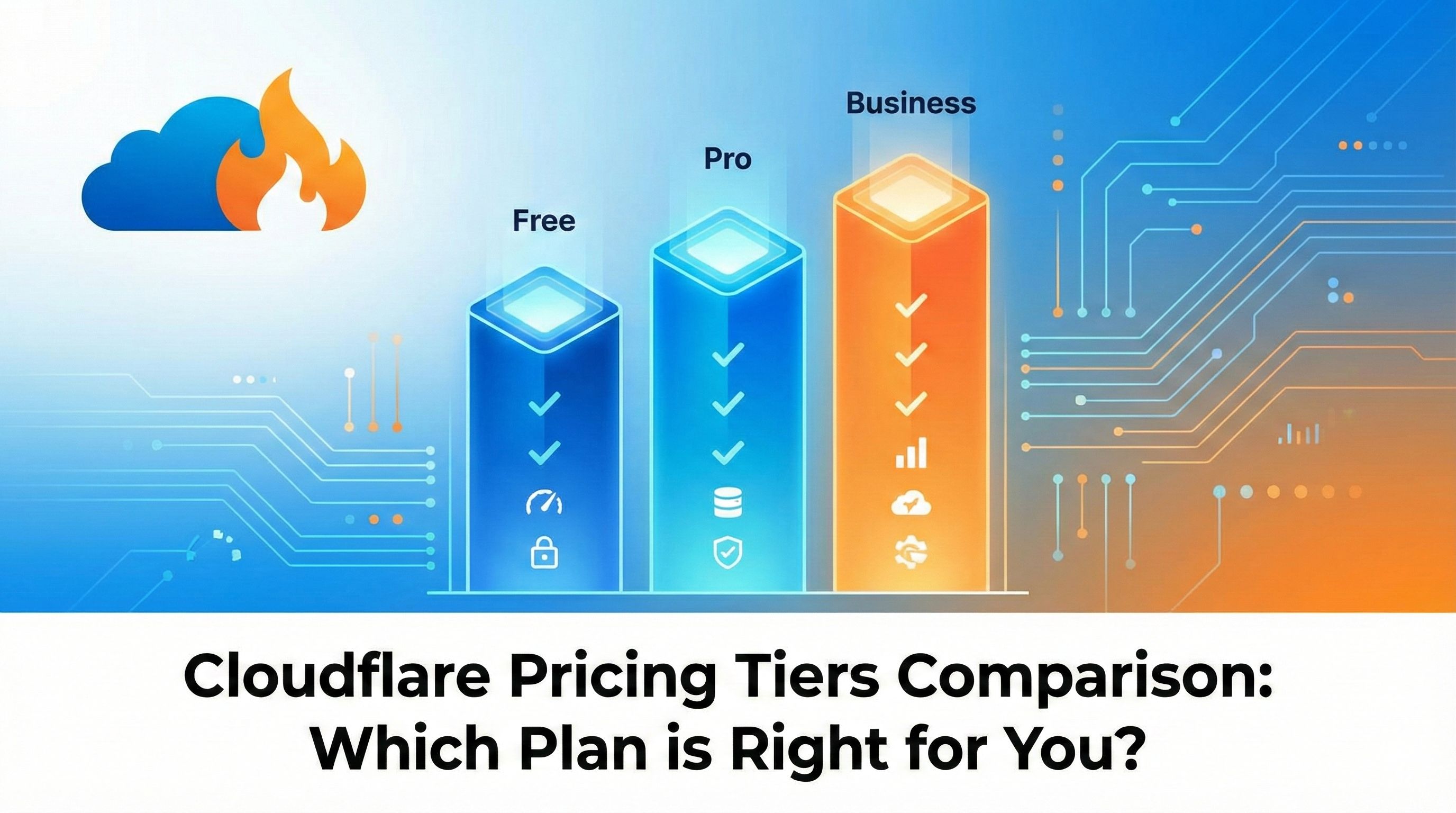
Quick Comparison Table: Four Pricing Tiers
Here’s a complete overview for quick reference:
| Feature | Free Plan | Pro Plan | Business Plan | Enterprise Plan |
|---|---|---|---|---|
| Monthly Fee (per domain) | $0 | $20 | $200 | $2000+ |
| Custom WAF Rules | 5 rules | 20 rules | 100 rules | 1000 rules |
| Page Rules | 3 rules | 20 rules | 50 rules | 125 rules |
| Managed Rulesets | Basic | Full OWASP | OWASP Enhanced | Complete + Threat Intel |
| Bot Management | Basic | Basic | Advanced (ML + Behavior) | Enterprise-grade |
| DDoS Protection | Standard Unlimited | Standard Unlimited | Advanced Unlimited | Enterprise + SLA |
| Image Optimization | ✗ | ✓ | ✓ | ✓ |
| China Network | ✗ | ✗ | ✗ | ✓ (ICP required) |
| SLA Guarantee | ✗ | ✗ | ✗ | ✓ |
| Dedicated Support | Ticket | Ticket | Priority Ticket | 15-min Response |
The Truth About Free Plan: Is Traffic Really Unlimited?
Bottom line first: Cloudflare’s free plan indeed has no explicit traffic cap, but that doesn’t mean you can use it mindlessly.
The official stance is quite interesting. They’ve never said “free plan limited to XX TB,” but the terms of service have a vague requirement: ensure your request structure is reasonable, with HTML requests exceeding 50% of total requests. In plain English: you can use it for CDN and protection services, but don’t treat Cloudflare as a free object storage or video streaming server.
A real-world example illustrates this well. A webmaster on the V2EX forum shared that his website ran 20TB of monthly traffic on the free plan, and Cloudflare never sent any warning emails. Another case: Cloudflare once helped a free-plan client block 26 million DDoS requests per second—at no charge. With other providers’ paid firewalls, the bill would’ve been bankruptcy-inducing.
So when might you get flagged?
Mainly these scenarios:
- Video/large file distribution: If most traffic is videos, software packages, or other large files with HTML requests below 30%, that’s risky
- Extreme traffic levels: Reports suggest that if monthly traffic exceeds 100TB, Cloudflare may email suggesting an Enterprise upgrade ($2000/month per domain). No response might result in forced origin bypass
- Malicious attack traffic: Using it for proxy pools, traffic farming, or other obvious violations will get your account banned
But honestly, for most personal blogs and SMB websites, the free plan is plenty. I’ve seen sites with millions of monthly pageviews staying on the free plan, with Cloudflare still providing stable DDoS protection and CDN acceleration.
Pro Plan ($20/month): Worth the Upgrade?
I struggled with this question for a while. Twenty dollars a month doesn’t sound like much, but that’s $240 annually—not a small amount for individual webmasters. So what does the Pro plan actually add?
You might think: I don’t understand security, so what good are more WAF rules? Honestly, that’s where the Pro plan’s real value lies.
WAF (Web Application Firewall) is simply your website’s security guard. The free plan gives you 5 custom rules, which sounds like plenty, but you’ll quickly find it’s not enough. For example, if you want to block malicious IP ranges, limit API call rates, and prevent SQL injection—these three needs alone use up 3 rules. Want more fine-grained protection? Five rules won’t cut it.
The Pro plan gives you 20 rules, and more importantly, unlocks the complete OWASP ruleset. OWASP is the authoritative standard in web security, covering SQL injection, XSS attacks, command injection, and other common threats. The free plan’s managed rules only defend against basic attacks; the Pro plan is like hiring a professional security team.
There’s another easily overlooked point: Page Rules. The free plan only has 3, which sounds sufficient but gets awkward in practice.
For example:
- Rule 1: Redirect root domain to www (www.example.com)
- Rule 2: Configure static resource caching (/static/*)
- Rule 3: Configure no caching for API paths (/api/*)
See? Just the basic configuration uses all 3 rules. If you want to optimize caching for different pages or set security rules for specific paths, you’re out of luck. The Pro plan’s 20 Page Rules are much more flexible, allowing fine-tuned configurations for different business scenarios.
When Should You Upgrade to Pro?
My suggestion—watch for these signals:
- WAF rules insufficient (exceeding 5 needs)
- Need complex caching strategies (Page Rules exceeding 3)
- Website has image-heavy content (Pro’s image optimization saves bandwidth)
- Starting to have stable revenue, willing to pay for professional protection
Interesting data point: Cloudflare says over 50% of Pro users upgraded from the free plan. What does this tell us? People don’t start by paying—they use the free plan until it’s not enough, then upgrade. That’s the path I recommend: freeoad first, consider paying when you hit real bottlenecks.
Business Plan ($200/month): What Does 10x the Price Buy?
Jumping from Pro’s $20 to Business’s $200 is a 10x price increase. This tier isn’t something individual webmasters can casually try—you need clear business requirements to consider it.
So what does this 10x price difference get you?
Core differences in three areas:
1. WAF Rules Skyrocket from 20 to 100
Sounds like just a quantity change, but 100 rules means you can implement very granular security strategies. For instance, e-commerce sites can configure different rate limits and IP blacklists for login, payment, and inventory APIs separately, with plenty of rules left for emergencies.
2. Bot Management: A Quantum Leap
This is the Business plan’s most valuable feature. Free and Pro plans’ bot protection is basically “check IP characteristics + User-Agent”—basic methods that tech-savvy scrapers can easily bypass.
The Business plan’s bot management uses three approaches:
- Machine Learning: Analyzes behavior patterns to identify automated programs
- Behavior Analysis: Monitors mouse trajectories, page dwell time, and other human characteristics
- Fingerprinting: Identifies devices through browser fingerprints and TLS fingerprints
Real scenario: You run a ticketing website where scalpers’ scripts fire hundreds of requests per second. The free plan’s WAF can only restrict by IP, but scalpers use proxy pools—changing IPs faster than changing clothes. The Business plan’s bot management can identify “this isn’t human operation” through behavioral characteristics and block it directly, with over 95% accuracy.
3. Advanced DDoS Protection
Pro plan’s DDoS protection is already solid, but Business goes further. Attack response is faster, protection strategies are smarter, and it can customize defense against application-layer attacks (like HTTP Flood).
Who Should Use the Business Plan?
Bluntly, these scenarios justify the $200:
- E-commerce Platforms: Need fine-grained anti-scraping to prevent competitors from stealing prices and inventory data
- API Service Providers: High request volume requiring complex rate limiting strategies
- High-Traffic Content Sites: Daily pageviews in the millions, demanding extreme caching and performance
- Compliance-Required Enterprises: Finance, healthcare industries where security compliance is mandatory
If you’re a personal blogger or small business site, honestly, the Business plan is overkill. The Pro plan or even the free plan suffices—save that $200 for content or ads instead.
Enterprise Plan: The Customized Behemoth
The Enterprise plan pricing is “contact sales,” with an actual starting price around $2000/month per domain. This tier isn’t on most people’s radar, but for large enterprises, government agencies, and financial companies, these exclusive features are worth the price.
Enterprise Plan’s Killer Features:
1. 1000 Custom WAF Rules
Yes, you read that right—1000 rules. This scale allows building extremely complex security strategy matrices. Large e-commerce or financial platforms have dozens of subsystems, each with unique security needs—1000 rules are what’s needed.
2. China Network Access
This feature is particularly important for the Chinese market. Enterprise customers can, after website ICP filing, access Cloudflare’s China network nodes through Baidu Cloud partnership. This means your site’s access speed for Chinese users can improve by an order of magnitude, with latency dropping from hundreds of milliseconds to tens.
For foreign companies doing business in China, or Chinese companies serving overseas markets, this feature is essential.
3. SLA Guarantee + Dedicated Account Manager
Cloudflare Enterprise provides formal SLA (Service Level Agreement), guaranteeing uptime and incident response times. Plus dedicated account managers and technical support teams who can address issues immediately.
Free and Pro plans can only submit tickets, with response times potentially hours or even days. Enterprise can respond within 15 minutes—critical for mission-critical operations.
4. Advanced Threat Intelligence
Machine learning-based threat detection can identify zero-day attacks, APT (Advanced Persistent Threats), and other sophisticated attack methods. This level of protection doesn’t exist in free or Pro plans.
Who Needs Enterprise?
Honestly, this tier isn’t measured by money alone—it’s about needs:
- Large Enterprises: Annual revenue tens of millions USD+, where one hour of downtime costs hundreds of thousands
- Financial Institutions: Must comply with PCI DSS, SOC 2, and other regulations
- Government Agencies: Extreme requirements for data security and availability
- Multinational Corporations: Need both domestic China and overseas node coverage
If your business hasn’t reached the “site crash = company crisis” level, the Enterprise plan is wasteful.
Upgrade Decision Guide: 5 Criteria
After all this comparison, you might still be uncertain which tier suits you. Here are 5 concrete criteria to guide you.
Criterion 1: WAF Rule Needs Test
Open your Cloudflare dashboard and check how many WAF rules you’ve configured. If you’re already using 4-5 rules and have new security needs you can’t implement, consider upgrading to Pro.
Specific scenarios:
- Free plan sufficient: Simple IP blacklists, basic SQL injection protection
- Upgrade to Pro: Need to configure rate limiting for multiple API endpoints, complex geo-blocking strategies
Criterion 2: Page Rules Hunger Level
This one’s straightforward. With the free plan’s 3 Page Rules, if you find:
- Caching strategies you can’t configure
- Want different treatments for different paths but no rules available
- Every new need requires deleting old rules to make space
Congratulations, time to upgrade. Pro’s 20 Page Rules solve 95% of configuration needs.
Criterion 3: Bot Traffic Percentage Analysis
This requires running data for a while. Check “Analytics” in your Cloudflare dashboard for traffic composition. If you discover:
- Bot traffic exceeds 20% and impacts server load
- Frequent malicious scraping attempts
- Clear automated attack behavior
Then the Business plan’s advanced bot management is worth the investment. But if bot traffic is under 10%, or it’s all friendly crawlers like search engines, the Pro plan suffices.
Criterion 4: Compliance and SLA Requirements
This mainly depends on your business nature:
Need Enterprise:
- Formal compliance requirements (finance, healthcare, government)
- Need to sign SLA agreements
- Service interruptions cause significant losses (over $1000/hour)
Don’t Need Enterprise:
- Personal projects, startups
- Occasional downtime of a few minutes is acceptable
- No mandatory compliance requirements
Criterion 5: Cost-Benefit Calculation
Finally, let the numbers talk. Do the math:
Is Pro ($20/month) Worth It?
- If website monthly revenue exceeds $500: Worth investing—security protection and performance improvements bring better user experience
- If website isn’t profitable or revenue is below $200: Stick with free plan, spend the money on content and promotion
Is Business ($200/month) Worth It?
- If website monthly revenue exceeds $5000 and you’ve experienced bot attacks: Worth it
- If revenue is below $3000: Not worth it—that money is better spent on servers or hiring staff
Quick decision flowchart:
Start
  ↓
Is free plan sufficient? (WAF rules <5, Page Rules <3)
  ├─ Yes → Continue with free plan
  └─ No → Consider Pro plan
      ↓
Is bot traffic over 20%?
  ├─ Yes → Consider Business plan
  └─ No → Stay on Pro plan
      ↓
Have compliance/SLA requirements?
  ├─ Yes → Consider Enterprise plan
  └─ No → Stay on current plan
Money-Saving Tips and Common Misconceptions
After using Cloudflare for years, I’ve hit some pitfalls and discovered money-saving tricks. Here’s what can help you avoid 90% of payment traps.
Misconception 1: Thinking the Free Plan Has Hard Traffic Caps
This is the biggest misconception. I’ve seen many people just starting with the free plan get anxious: “Will my site suddenly get throttled?” In reality, as long as HTML requests exceed 50%, tens of TB of traffic is fine.
Cloudflare’s official blog has a case study: they helped a free-plan client block 26 million DDoS requests per second—at zero cost. This “internet saint” characteristic is truly rare.
Misconception 2: Thinking All Pro Features Must Be Used
Many people upgrade to Pro and find many advanced features unused, feeling it’s wasteful. Actually, Pro’s value concentrates in WAF rules and Page Rules—image optimization and mobile optimization are bonuses.
If you just want more WAF rules, Pro is worth it. If you want bot management, that requires the Business plan. Don’t pay for “seems useful” features.
Misconception 3: Upgrading All Domains to the Same Plan
Cloudflare charges per domain. If you have 3 websites and upgrade each to Pro, that’s $60/month.
The smart approach:
- Main site (high traffic, high revenue) → Pro plan
- Test sites, personal blogs → Free plan
- API services (high bot traffic) → Business plan
Prioritize strategically to save significantly.
Tip 1: Fully Utilize Workers Free Quota
Cloudflare Workers is great, with a free daily quota of 100,000 requests. Many lightweight needs (like simple URL redirects, request rewrites) can be implemented with Workers, saving precious Page Rules.
Example: You want to redirect all HTTP requests to HTTPS. Instead of using a Page Rule, write a 10-line Worker to handle it—you can even add custom logic.
Tip 2: Plan Page Rules Wisely to Avoid Waste
The free plan only has 3 Page Rules—budget carefully. My suggestion:
Reserve for these scenarios:
- Force site-wide HTTPS (essential)
- Static resource caching configuration (performance improvement)
- Dynamic content caching strategy (adjust by business needs)
Don’t use Page Rules for:
- Simple redirects (use Workers or server configuration)
- IP blocking (use WAF rules)
Tip 3: Annual Payment May Offer Discounts
While not officially advertised, if you contact Cloudflare sales directly, annual payment might get you discounts. Especially for Business and Enterprise plans, there’s more negotiation room.
For Pro plans, if you’re certain about long-term use, try asking customer service about annual discounts. Reportedly, some people have secured 20% off.
Tip 4: Leverage Free Plan’s Advanced Features
Many people don’t know the free plan actually has quite a few advanced features:
- Free SSL Certificates: Let’s Encrypt certificates, auto-renewal
- DDoS Protection: Basic protection free and unlimited
- CDN Acceleration: Global nodes, unlimited traffic
- DNS Resolution: One of the world’s fastest public DNS services
These features might cost money with other CDN providers—Cloudflare gives them free.
Frequently Asked Questions
Q1: Does the free plan really have no traffic limits?
A: No hard limits, but usage rules exist. As long as HTML requests exceed 50% and you use it reasonably, tens of TB of traffic won’t be restricted. Don’t use it for video streaming or pure file distribution.
Q2: When must I upgrade to Pro?
A: Two situations: ① WAF rules exceed 5 needs; ② Page Rules exceed 3 needs. If you haven’t hit either, keep using the free plan.
Q3: Is Business plan’s bot management really worth $200?
A: Depends on the scenario. If your site is plagued by malicious scrapers, or you’re running e-commerce/API services needing precise bot identification, absolutely worth it. If you just have occasional scraper traffic, Pro suffices.
Q4: Can I downgrade after upgrading?
A: Yes, but it’s billed monthly with no refunds for the current month. Best to upgrade at month-start for testing, and downgrade before month-end if unsuitable, maximizing the monthly fee.
Q5: Can multiple domains share one Pro plan?
A: No, Cloudflare charges per domain. Each domain is priced separately—to save money, prioritize and only upgrade core sites.
Conclusion
After all that, here’s a one-sentence summary:
- Free Plan: Suits 99% of individual webmasters and small sites—no traffic caps, sufficient features
- Pro Plan ($20/month): First choice when WAF rules and Page Rules are insufficient—best value
- Business Plan ($200/month): Exclusive option for e-commerce and API services suffering serious bot attacks with massive traffic
- Enterprise Plan ($2000/month+): Reserved for large enterprises, financial institutions, organizations with compliance requirements
Core recommendation: Don’t rush to pay—push the free plan to its limits first.
I’ve seen too many people build a site and immediately want to upgrade to paid plans, only to find they don’t use the features. Cloudflare’s free plan is already stronger than other providers’ paid versions—DDoS protection, CDN acceleration, SSL certificates all included, unlimited traffic.
When you truly hit bottlenecks—WAF rules insufficient, Page Rules maxed out, bot traffic seriously affecting operations—that’s when to upgrade, and every cent spent will be worthwhile.
Final thought: Which Cloudflare plan are you using now? Have you encountered any limitations? Feel free to share your experience in the comments.
Published on: Dec 1, 2025 · Modified on: Dec 4, 2025

Related Posts

Complete Guide to Deploying Astro on Cloudflare: SSR Configuration + 3x Speed Boost for China
Building an Astro Blog from Scratch: Complete Guide from Homepage to Deployment in 1 Hour